Buckwheat Kasha with Mushrooms
Take your time. Don't worry.
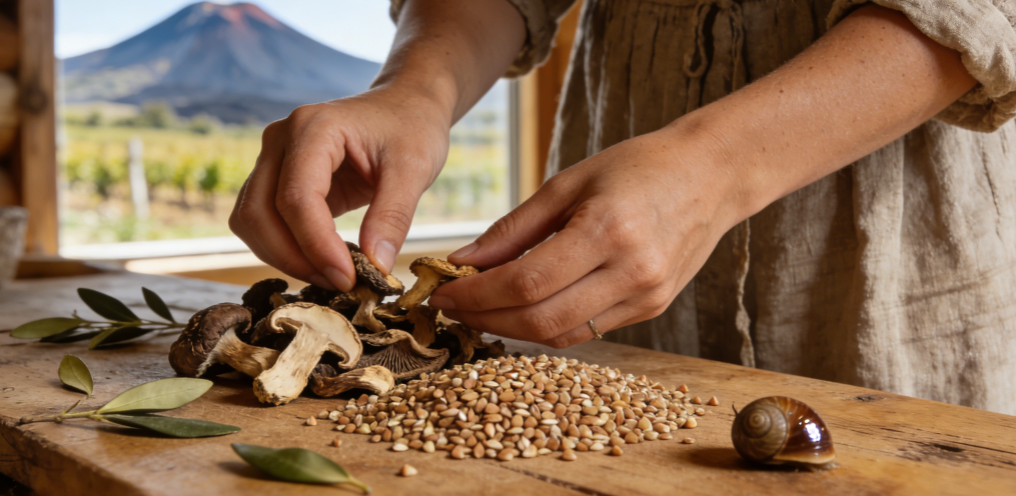
There is still dew hanging on the olive leaves in the early morning, and the fragrance of olives is in the wind. A wisp of light smoke floated from the Etna crater, like a dream that had not yet woken up. I stood for a while in front of the wooden window of the farm hut, holding in my hand the porcini mushrooms I had just picked from the forest. The soil was still stuck to the umbrella, wet. When I was sorting out the mushrooms just now, I found a small snail lying on the stalk, crawling slowly. I didn't drive it away. We are all the same, on this morning, not in a hurry to go anywhere.
Today I want to talk about soba kasha. Kasha。 Grechka。 Friends in Eastern Europe often say that this is the most real hug given by the land. But many people are prejudiced against buckwheat. I think it's "poor food" or the monotonous, rough base of a fitness meal. Boiled out or hard to the point of being sandwiched, teeth; or soft and listless. If the mushrooms are not handled well, the earthy smell can ruin a pot of soup. Everyone doesn't understand the rustic power of this farm dish, and they don't know how to choose a good buckwheat with the right mushrooms.
In fact, good food does not need a story, but every story needs good food, and the story of buckwheat kasha begins with a drought-tolerant fruit.
The reason is simple. Yesterday in the forest at the foot of the volcano, I stepped on these wild porcini mushrooms. The aroma is wild, with notes of pine needles and rotten leaves. Suddenly I remembered that an Eastern European friend said that buckwheat is the best partner for mushrooms. One is the skeleton of the land, and the other is the soul of the forest. This pair seems to be destined to meet. I decided to stop extracting oil and study the "land and forest" pair.
I remember the first time I cooked buckwheat, I was so impatient. There is less water, and the bottom of the pot is burnt, giving off a bitter taste. The mushrooms are not soaked thoroughly, and they are full of sand when you bite into them. The ideal taste of "clear grains and warmth" cannot be found. I was in Milan at the time, in a hurry to eat quinoa salad in order to catch up with the next meeting. Food is just fuel. Now it's different. Here, time is wasted on ingredients.
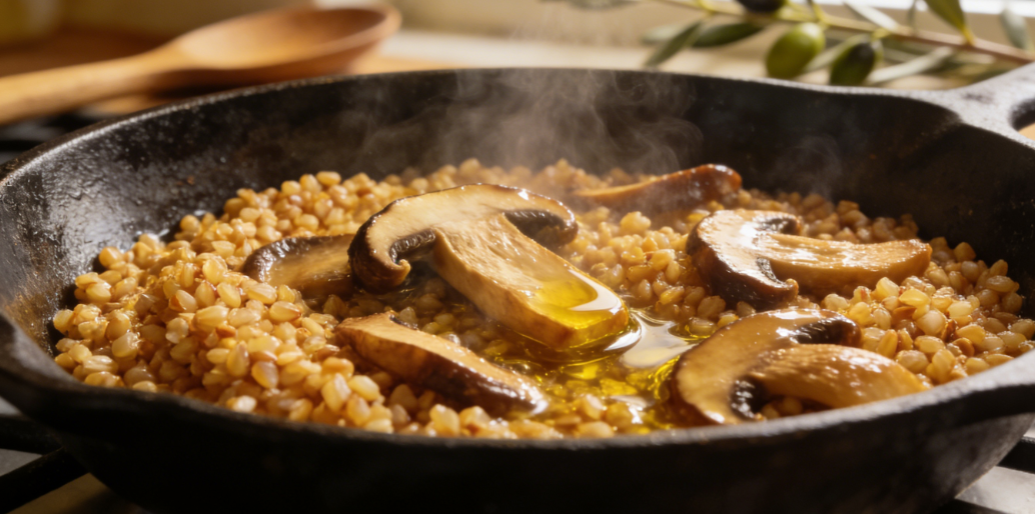
Later, I consulted a Ukrainian buckwheat farmer. She told me the secret was simple: "Don't stir, cover and stew." First, sauté the mushrooms with our olive oil to stimulate that deep nutty smell, then mix in the buckwheat. Take your time. Don't worry.
Finally, I cooked the golden buckwheat kasa. The aroma of mushrooms is so strong that you want to close your eyes. Sit under the olive tree and mix the bowl with the farm's freshly pressed olive oil. The simplicity of buckwheat and the wildness of mushrooms are all gifts of the land. Only by slowing down can you understand the language of the ingredients.
Choose ingredients as carefully as olives. You can't just look at the packaging.
Buckwheat has different origins and very different temperaments. some are impatient and rot when cooked; Some are calm, and the more you chew, the more fragrant they become. I made a simple comparison, just have a number in mind, no need to memorize.
| Origin | Particle characteristics: | Cooking differences | Taste flavor |
|---|---|---|---|
| Russia/Ukraine | The grains are full, dark brown in color, and baked | It absorbs water quickly, requires less water, and is easy to form | Smoky, nutty, and chewy |
| Northern China | The grains are slightly smaller, light green or light brown in color, and not baked | Slow water absorption, high water demand, easy to disperse | The herbs are fragrant, the taste is soft and glutinous, and it is suitable for cooking porridge |
| North American organic | The grains are homogeneous, golden in color, and lightly roasted | Good stability, not easy to paste the bottom | Light and versatile, it is suitable as a salad base |
You see, just like olives have the difference between Frantoio and Nocellara, buckwheat also has its character. To make Kasha, I prefer the dark brown and baked ones from Eastern Europe. The smoky flavor is a natural match with wild mushrooms.
This is especially true for dried mushrooms. Those scraps in the supermarket, no. What we want is a complete umbrella cover, a memory of the forest.
- Look at the color: high-quality dried porcini mushrooms should be natural beige or light brown, too white may be smoked with sulfur, too black may be damp and moldy.
- Smell the aroma: pick up one and bring it close to the tip of your nose. There should be a strong woody and earthy fragrance, if there is a musty or sour smell, throw it away.
- Texture: dry, brittle and hard. It can be broken with a gentle break, but it will not break into powder. If it is soft, it means that it is not stored properly.
When soaking mushrooms, the water should be warm. Do not use boiling water, it will burn its soul.
Wait, this buckwheat is not the right color. It's too light. Aged? Smell it. There's no nutty smell. Not true. Change the pack.
Soaking mushrooms, suddenly - wait, the dog in the olive grove is barking. Probably the car that delivered the oil extraction equipment is coming. Take a look. Come back and continue. No rush.
There is also a trick to prevent buckwheat from cooking into a paste. Many people like to stir while cooking, afraid of sticking to the pan. In fact, it's the opposite.
- Stir-fry first and then cook: Stir-fry the buckwheat grains in olive oil for two minutes until they smell fragrant and the surface changes color slightly. This locks in the starch and makes the grains distinct.
- Add enough water at once: Add enough water at once, don't add water halfway through. The ratio is about 1:2, but add it by feeling. Just look at the water surface one knuckle higher than the buckwheat.
- Never stir: After the water boils, turn to minimum heat and cover with a lid. Never remove the lid, do not stir. Let the steam circulate inside and simmer slowly.
When picking mushroom sand, the soil is embedded in the nail cracks, which is a bit rough. But when I touched the dry fungus umbrella, I felt at ease. The buckwheat granules are in the hand, a little prickly. But when poured into the pot, the sound was very pleasant. Rustling. Like rain.
To be fair, before in Milan I wouldn't pay attention to these at all. Time was money back then. Now, time is the sun, it is the wind, and it is this pot of slowly simmered buckwheat.
What's more, when you mix virgin olive oil into the freshly cooked kasha, the layer of oil wraps around each buckwheat, and the mushroom juice seeps in. At that moment, the Mediterranean sun merged with the forests of Eastern Europe. No complex seasoning is required. Salt, a little. Black pepper, freshly ground. That's enough.
Good food doesn't need to be deliberately told a story. It is powerful in itself.
I mixed the last bite of soba kassa. The olive oil bottle was still open. A wisp of smoke wafted from the crater in the distance. I'll have to go see if I'm going to harvest the olives.